
Most people imagine a truck driver working alone: one driver, one tractor-trailer, and hundreds of miles of highway ahead. That is how many trucking jobs operate, but there is another model designed to keep freight moving for much longer periods each day — team truck driving.
Team truck driving normally means two qualified commercial drivers share the same truck and the same freight assignment. While one driver operates the vehicle, the other driver rests, usually in the sleeper berth. After the active driver's available driving time is used or the team reaches a planned changeover point, the drivers switch.
The major advantage is simple. A solo driver eventually has to stop the truck for a long rest period. With a properly managed team operation, the second driver may be able to take over while the first driver rests. As a result, the tractor-trailer can potentially cover substantially more distance in a 24-hour period than a solo truck.
That makes team driving particularly useful for long-distance and time-sensitive freight.
However, team trucking is not simply a way to drive continuously around the clock. Each driver has an individual Hours-of-Service clock and must comply with the same federal driving and rest limits that apply to other property-carrying commercial drivers. Under the standard federal rules, an individual property-carrying driver generally may drive up to 11 hours after 10 consecutive hours off duty and may not drive beyond the 14th consecutive hour after coming on duty.
Team driving therefore depends on careful scheduling, accurate ELD records, proper rest, and two drivers who can comfortably live and work together inside a relatively small truck for days or weeks at a time.

How Does Team Truck Driving Work?
In a typical team operation, both drivers are qualified to operate the tractor-trailer. Instead of assigning the truck to one person, the carrier assigns it to the pair.
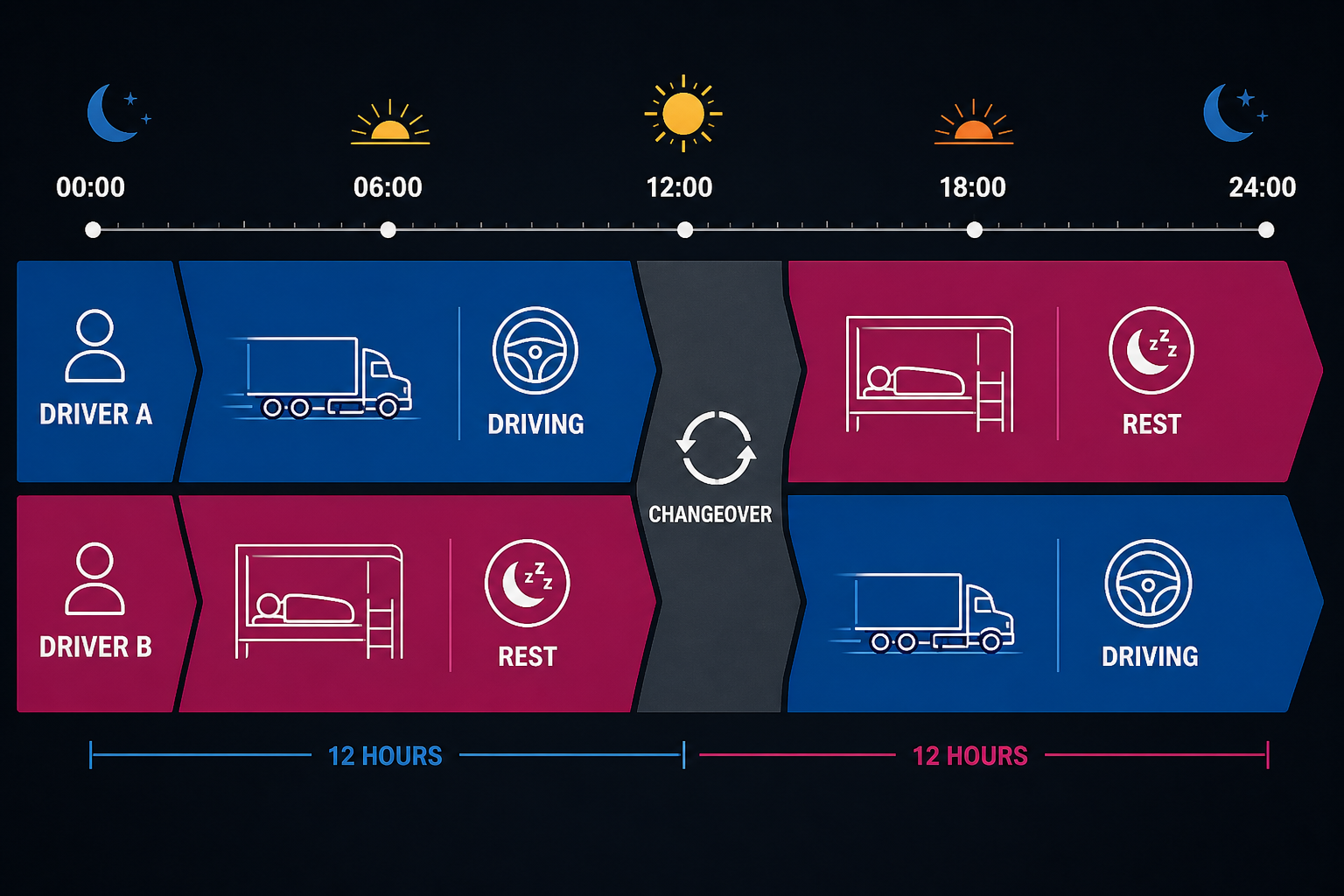
Driver A might begin the trip while Driver B rests. Several hours later, they switch positions. Driver B takes control of the truck while Driver A begins a qualifying rest period.
This rotation allows the truck to remain productive during periods when a solo truck would normally need to be parked.
Imagine a shipment traveling approximately 2,000 miles across the country.
A solo driver cannot simply drive those 2,000 miles without stopping. Federal Hours-of-Service rules limit how many hours an individual driver may operate before taking required rest. Loading delays, fueling, traffic, weather, parking, and customer appointments also reduce the number of miles that can realistically be completed each day.
A team has two separate driving clocks.
If both drivers have available hours and the operation is planned correctly, one person can take over after the other finishes a driving shift. Instead of parking the truck for a full overnight rest period every time one driver's clock expires, the vehicle may continue toward the destination.
This does not mean the truck literally travels 24 hours every day without interruption.
Teams still need to fuel, inspect equipment, use restrooms, eat, pick up and deliver freight, wait at customers, deal with traffic, enter weigh stations, and sometimes stop because of weather or mechanical problems.
But compared with a solo operation, the truck can spend far more of each day moving.
How Many Hours Can a Team Truck Drive?
This is one of the most commonly misunderstood parts of team trucking.
A team does not receive one shared 22-hour driving clock.
Each driver has their own Hours-of-Service limits.
Under the standard federal rules for property-carrying drivers, each individual generally may drive a maximum of 11 hours after 10 consecutive hours off duty. Driving must normally occur within the driver's 14-consecutive-hour driving window after coming on duty. A driver also generally needs a 30-minute interruption after 8 cumulative hours of driving without a qualifying 30-minute interruption, and the normal 60-hour/7-day or 70-hour/8-day limits still apply.
Because there are two drivers, however, their schedules can overlap in a way that keeps the vehicle moving much longer.
In a highly efficient operation, two drivers with full available clocks could theoretically provide close to 22 total driving hours between them before both need additional qualifying rest.
Real life is usually less perfect.
A team might lose time during:
- Fuel stops
- Pre-trip inspections
- Loading and unloading
- Traffic congestion
- Meal and shower stops
- Driver changes
- Weigh stations
- Repairs
- Weather delays
So a team truck does not automatically cover twice as many miles as a solo truck.
But it can often travel significantly farther within the same calendar day.
That increased utilization is the main reason carriers use teams for freight where transit time matters.
How Does Sleeping Work in a Team Truck?
Sleeping is one of the biggest adjustments new team drivers have to make.
Modern OTR tractors usually have a sleeper compartment behind the seats. Depending on the tractor configuration, the sleeper may contain one or two bunks along with storage cabinets, a refrigerator, microwave, electrical outlets, heating and air conditioning, and other basic equipment.
When one member of the team is driving, the other may spend qualifying rest time in the sleeper berth.
FMCSA's standard sleeper-berth provision allows a property-carrying driver to split the required 10-hour off-duty period when the requirements are met. One qualifying period must include at least 7 consecutive hours in the sleeper berth, while the other must be at least 2 consecutive hours off duty or in the sleeper berth, and the two periods must total at least 10 hours. When properly paired, neither qualifying period counts against the driver's 14-hour window.
Many teams may instead organize schedules around longer uninterrupted rest periods when practical.
The difficult part is that the truck may still be moving while you are trying to sleep.
Road vibration, acceleration, braking, highway noise, rough pavement, curves, construction zones, and temperature changes can all make sleeping in a moving tractor more difficult than sleeping in a parked truck.
Some drivers adapt quickly.
Others discover that they simply cannot get high-quality rest while another person is driving.
That matters because being technically off duty does not automatically mean a person is well rested. If a team driver consistently sleeps poorly while the truck is moving, fatigue can become a serious problem when it is their turn to drive.
A successful team therefore needs a schedule that allows both people to obtain enough actual rest, not merely enough hours on the ELD.
How Do ELDs Work With Two Drivers?
Team drivers normally maintain separate Hours-of-Service records, even though they are operating the same tractor.
When both drivers are logged into the same Electronic Logging Device, the ELD must be capable of displaying data for both co-drivers. FMCSA also allows the inactive co-driver to make entries to their own records while the vehicle is moving, although the drivers cannot switch the active driving role on the ELD while the vehicle is in motion.
This makes correct driver identification extremely important.
Before moving the truck after a driver change, the team should make sure the correct driver is assigned as the active driver in the logging system.
Otherwise, driving time could accidentally be recorded on the wrong person's log.
For most drivers who are required to maintain Records of Duty Status, the ELD rule applies unless they qualify for one of the limited exceptions.
Team drivers therefore need to understand not only their personal driving clocks but also how their carrier's specific ELD system handles co-driver accounts.
A good team should never rely on one driver to manage both people's logs.
Each person remains responsible for the accuracy of their own record.
What Does a Typical Team Trucking Schedule Look Like?
There is no single schedule used by every team.
Some teams prefer long blocks in which each driver handles most of a full driving shift before switching.
For example, one driver might prefer to drive during the day while the other prefers nights. If their schedules and available hours permit it, the pair can develop a predictable rotation.
Driver A may drive from early morning into the afternoon.
Driver B rests during most of that period.
Later, they switch. Driver B handles the evening and overnight driving while Driver A rests.
This arrangement can work particularly well when the drivers naturally prefer different sleep schedules.
Other teams switch more frequently because of pickup appointments, mountain routes, traffic patterns, customer schedules, or personal preferences.
A team may also intentionally assign certain sections of a route to the person who handles them better. One driver might be more comfortable with mountain passes while the other prefers heavy urban traffic.
The most important factor is that the schedule must fit within each driver's legal Hours of Service and provide meaningful rest.
A team that constantly changes shifts with no consistent sleep pattern may technically keep the truck moving but eventually create exhausted drivers.
The most productive teams are usually not the ones that simply drive the maximum possible number of hours every day.
They are the ones that develop a sustainable system.
Why Do Trucking Companies Use Team Drivers?
The main reason is transit time.
A truck is a productive asset only when it is moving freight. In a solo operation, the truck spends a substantial part of every 24-hour period parked while the driver takes mandatory rest.
With a team, one person can often rest while the second person continues driving.
That can make team operations attractive for shipments that need to cross long distances quickly.
Examples may include expedited freight, automotive components needed for production, certain medical or pharmaceutical shipments, high-value freight, critical replacement parts, and other loads where a customer is willing to pay for faster transportation.
Teams can also be useful on ordinary OTR routes when the carrier has enough long-distance freight to support the additional mileage.
A team truck might travel from California to the Midwest or from the East Coast to Texas with fewer long stationary periods than a solo truck.
This gives carriers the ability to provide truckload service that begins to approach the transit times of more expensive transportation options for certain shipments.
However, team service only makes financial sense when there is enough freight.
Putting two drivers in a truck that regularly spends hours waiting at warehouses defeats much of the purpose.
The operation works best when the carrier has long, consistent lanes and customers that keep the truck moving.
Team Truck Driving vs. Solo Truck Driving
The biggest difference is not simply the number of people in the cab.
It changes almost every part of the job.
| Factor | Solo Truck Driving | Team Truck Driving |
|---|---|---|
| Drivers in truck | One | Two |
| Potential daily truck movement | Limited by one driver's HOS | Significantly higher with alternating drivers |
| Privacy | Much higher | Very limited |
| Sleeper use | Usually while truck is parked | Often while truck is moving |
| Trip planning | One driver's schedule | Two separate HOS clocks |
| Truck space | One person uses sleeper/storage | Space shared between two people |
| Decision-making | Mostly individual | Requires cooperation |
| Potential miles | Lower | Often higher |
| Best suited for | Standard OTR, regional, independent drivers | Long-distance and time-sensitive freight |
For many people, solo trucking offers the classic OTR lifestyle.
You control the temperature, music, radio, cleanliness, food, stopping schedule, and organization of the sleeper. When you park, the truck remains parked until you decide to move again.
Team driving gives up much of that independence in exchange for potentially more miles and faster freight movement.
Neither is automatically better.
They are simply different ways of working.
Do Team Truck Drivers Make More Money?
Team drivers can earn more than comparable solo drivers, primarily because the truck may cover more miles.
But team pay can be confusing, and drivers need to understand exactly how a carrier calculates compensation before accepting a job.
One company might advertise a team rate based on the total miles traveled by the truck and then divide the compensation between the two drivers.
Another might quote a cents-per-mile figure paid individually.
Some carriers may use guaranteed weekly pay, salary components, bonuses, or specialized compensation for expedited freight.
This creates a common recruiting problem.
Suppose a recruiter says a team truck averages 5,000 or 6,000 miles per week.
That does not necessarily mean each driver is personally driving 5,000 or 6,000 miles.
Those may be the total miles accumulated by the truck.
Likewise, a quoted team cents-per-mile figure needs context.
Is that amount paid to each driver?
Or is it the total amount paid to the truck and then split between the pair?
Before joining a team, ask the recruiter to show how an actual settlement works.
Ask about:
Total weekly truck miles. How many miles does the truck realistically average?
Pay per driver. What does each individual driver actually receive?
Training pay. Are you considered a team while one person is still a trainer?
Detention and layover pay. What happens when the truck cannot move?
Breakdown pay. Do both drivers receive compensation when the truck is in the shop?
Extra-stop pay. How is it divided?
A team job can have excellent earning potential.
But advertised numbers are meaningless until you understand how they translate into your paycheck.
Who Can Be Your Team Driving Partner?
Team partners come in many forms.
Some carriers match two drivers who did not know each other before joining the company.
Others allow drivers to choose their own partner.
Common teams include married couples, relatives, close friends, or two drivers who met during CDL training and decided to work together.
Husband-and-wife teams can be especially attractive to some carriers because the pair may already know how to live together and may share the same home-time schedule.
But knowing someone personally does not guarantee that you will work well together in a truck.
A good friend who is enjoyable to spend weekends with may become extremely difficult to live with inside a sleeper cab for three straight weeks.
Team compatibility involves much more than friendship.
Choosing the Right Team Partner
Your co-driver affects almost every hour of your working life.
You need to trust this person enough to sleep behind them while they operate a tractor-trailer at highway speed.
That alone makes partner selection extremely important.
Driving style is one major issue.
If one person drives smoothly while the other accelerates aggressively, follows vehicles closely, and brakes hard, the first driver may never be able to sleep comfortably in the berth.
Cleanliness matters too.
Two people are sharing a very small space. Food, clothing, shoes, bedding, trash, personal items, and hygiene habits can become sources of conflict surprisingly quickly.
Temperature is another common problem.
One person may want the sleeper cold enough to require a blanket while the other cannot sleep unless the truck is warm.
Music, phone calls, smoking, food, shower frequency, stopping habits, and sleep schedules can all cause friction.
Before agreeing to team together, discuss these things.
It may feel strange to have a serious conversation about cleanliness, air conditioning, or phone calls before taking the job.
It feels much worse to discover the disagreement 1,500 miles from home.
Trust Is Essential in Team Trucking
Solo drivers depend primarily on themselves.
Team drivers depend on another person every time they go to sleep.
When you climb into the sleeper berth while the truck continues down the highway, you are trusting your partner to make safe decisions.
You are trusting them not to speed through dangerous weather.
You are trusting them to recognize fatigue.
You are trusting them to inspect the equipment.
You are trusting them not to drive aggressively because they want to add another 30 miles to the shift.
And your partner is giving you exactly the same responsibility when the roles reverse.
That makes safety compatibility one of the most important parts of choosing a team driver.
A partner who consistently makes you uncomfortable behind the wheel is not a good team partner, regardless of how many miles the job offers.
What Happens When the Drivers Disagree?
Disagreements are inevitable.
The important question is how the team handles them.
Suppose one driver believes the road is too icy to continue, while the other thinks conditions are manageable.
Or one driver wants to keep moving another hour while the other feels too fatigued to safely take the next shift.
Safety decisions should never become a competition.
The correct goal is not to prove who is tougher.
The goal is getting both drivers, the truck, and the freight to the destination safely.
Teams should also agree in advance on basic operational questions such as where to fuel, how often to shower, how to divide customer check-ins, who handles paperwork, and how the sleeper is organized.
Small disagreements become much easier when expectations are clear.
Sleeping in a Moving Truck Can Be the Hardest Part
Many people considering team trucking focus on pay and mileage.
The bigger question may be:
Can you actually sleep while the truck is moving?
A sleeper berth is still inside a vehicle traveling at highway speed.
You may feel the truck accelerate onto the Interstate, slow for traffic, cross rough bridges, enter construction zones, climb mountains, or make turns.
Some road surfaces produce continuous vibration.
A driver who brakes aggressively can make sleeping particularly difficult.
Even fuel stops can interrupt rest. The truck slows, turns into a travel center, drives across the parking lot, stops at the pump, and starts moving again.
Over time, many experienced team drivers learn how to sleep through much of this.
Some never do.
If you consistently wake up after only four or five poor-quality hours of sleep, team driving may not be sustainable even if your ELD shows enough legal rest.
Fatigue is not something a driver should try to defeat through willpower.
Team Trucking Means Very Little Privacy
A sleeper tractor may look large from the outside.
It becomes much smaller when two people live inside it.
You share the cab, storage, refrigerator, sleeper, parking schedule, work schedule, and much of your personal time.
There may be days when the two of you are together almost continuously.
When the truck is moving, one person drives and the other rests.
When it stops for fuel, both people may wake up.
When it arrives at a customer, one or both drivers may need to become involved with paperwork or equipment.
When you finally stop for an extended break, your co-driver is still there.
For people who enjoy solitude, this can become one of the largest disadvantages of the job.
Teams that stay together successfully usually learn how to give each other personal space whenever possible.
One person might go inside the truck stop while the other remains in the cab.
During longer stops, drivers may exercise, eat separately, call family, or spend some time outside the truck.
Small amounts of independence can make sharing the truck much easier.
Who Handles Pre-Trip Inspections?
Both drivers have responsibilities related to the safe operation of the truck.
A team should never develop the attitude that one person is "the inspection driver" and the other does not need to pay attention to the equipment.
The driver taking control needs to be satisfied that the vehicle is safe to operate.
Teams can work together, however.
For example, one driver may perform a more extensive inspection at the beginning of a trip while the second driver checks important areas during a later changeover or fuel stop.
Because team trucks can accumulate mileage quickly, equipment monitoring becomes especially important.
A solo truck might cover 500 or 600 miles during a productive day.
A team may potentially cover far more.
That means tires, brakes, fluids, lights, and other components can accumulate wear more quickly in calendar time because the truck simply spends more hours moving.
Teams should take advantage of fuel stops and driver changes to look over the equipment.
Team Trucks Can Accumulate Mileage Extremely Quickly
One interesting aspect of team operations is how quickly the odometer can increase.
A solo OTR tractor may spend a large portion of every night parked.
A productive team truck may remain in service for much more of the day.
That can mean the same tractor accumulates annual mileage much faster than a typical solo truck.
For the carrier, this can be financially useful because the truck generates more revenue miles.
But it also means maintenance intervals arrive more quickly.
Oil services, tire replacement, scheduled inspections, filters, and other mileage-based maintenance may come due sooner in calendar time.
Drivers who are assigned to a permanent team tractor should therefore pay close attention to upcoming maintenance.
Waiting "another couple of weeks" can represent a lot of additional mileage on a high-utilization team truck.
What Kind of Freight Do Team Drivers Haul?
Team drivers can theoretically haul many of the same trailer types and freight categories as solo drivers.
However, teams make the most financial sense when faster transit creates value.
That is why team operations are commonly associated with long-distance and time-sensitive freight.
A carrier may use teams for expedited shipments, automotive components, high-value products, critical industrial parts, certain temperature-sensitive shipments, or other freight that cannot spend an extra night parked.
Dry van and reefer team operations are common because both types of trailers are widely used for long-distance freight.
Some specialized operations may also use teams depending on customer needs.
The specific freight is less important than the basic economics.
If the customer needs a truck to cross a large distance quickly, having two qualified drivers can help reduce transit time.
Is Team Driving Good for New CDL Drivers?
It can be, but beginners need to understand the difference between team driving and driver training.
A new CDL holder may spend several weeks driving with an experienced trainer. During that period, two CDL holders may be in the truck, but the operation is not always the same as a permanent equal team.
The trainer is responsible for teaching and evaluating the new driver.
After training is complete, a company may offer the driver a permanent solo position or pair them with another qualified driver for team service.
For a beginner, working with a compatible and experienced co-driver can provide some benefits.
There is another professional driver available to discuss routes, backing situations, weather, customers, and equipment problems.
But there is also a danger in depending too much on the other driver.
Each team member eventually needs to be capable of independently operating the truck.
You should know how to perform inspections, back into docks, plan routes, manage your ELD, scale loads, communicate with dispatch, and make safety decisions without requiring your partner to supervise every task.
Husband-and-Wife Truck Driving Teams
Couples are one of the most recognizable types of trucking teams.
For some couples, team driving solves one of OTR trucking's biggest lifestyle problems: being separated for weeks at a time.
Instead of one person staying home while the other travels around the country, both partners work in the truck.
A successful couple may also be able to coordinate finances, home time, and career goals more easily because they share the same schedule.
But team trucking can put pressure on a relationship too.
Living and working together 24 hours a day is very different from living together while each person has a separate job.
There is very little physical separation between work life and personal life.
A disagreement about parking or fuel can follow both people into the sleeper.
Couples considering team trucking should therefore think seriously about whether they can separate operational disagreements from their personal relationship.
For the right couple, it can work extremely well.
For the wrong couple, the truck can become a very small place very quickly.
Advantages of Team Truck Driving
The biggest advantage is the potential for more miles.
If the carrier has enough freight, a productive team may keep the tractor moving much longer than a solo driver can. More miles can create greater earning potential, depending on how the carrier pays the team.
Another advantage is that the driver is not completely alone.
OTR trucking can be isolating. Team drivers have another person available for conversation, help with route planning, checking equipment, and handling difficult situations.
Long trips can also be completed more quickly.
A cross-country shipment that takes significantly longer with a solo driver may move much faster when two qualified drivers alternate.
Teams can also divide some non-driving tasks.
One person may check into the shipper while the other organizes paperwork. One can watch the truck while the other goes inside. During difficult situations, having another experienced driver available can be helpful.
But those advantages only exist when the team actually works well together.
Disadvantages of Team Truck Driving
The largest disadvantage is usually the lack of privacy.
Two adults living inside one sleeper tractor can become stressful.
Sleeping while moving is another major challenge. If you cannot rest properly, the extra mileage is not worth it.
Team drivers also have less control over their schedules.
A solo driver decides when to change music, adjust the cab temperature, stop for food, take a shower, or organize the sleeper.
A team needs to consider another person's needs.
There can also be disputes over mileage and workload.
One driver may feel they are doing more night driving, more city deliveries, more paperwork, or more difficult backing.
If the pay is divided equally, resentment can develop when one person believes the workload is not equal.
Finally, a poor partner can turn a good trucking job into a miserable one.
The company, equipment, freight, and pay may all be excellent.
If the two drivers cannot live together, the team will probably not last.
Questions to Ask Before Accepting a Team Driving Job
The most important questions are about how the job actually works rather than how it is advertised.
Find out how the carrier calculates pay and whether the quoted CPM is per driver or for the truck.
Ask how many miles established teams realistically average, not just what the company's best team achieved last month.
Find out whether the company assigns partners or allows drivers to select their own.
Ask what happens if your partner quits, goes on vacation, becomes sick, or decides they no longer want to team with you.
Understand home-time policies as well.
Does the team take home time together?
Can one person stay on the road while the other goes home?
What happens if the two drivers live in different states?
Equipment matters too.
Ask whether team trucks receive double bunks, refrigerators, APUs, inverters, and enough storage for two people.
Those details may sound less important than CPM during recruiting.
After three weeks inside the truck, they can become very important.
How Do You Know if Team Trucking Is Right for You?
Team trucking can be a good fit if you enjoy long-distance OTR driving, want access to high-mileage freight, and are comfortable sharing a small living space.
It also helps if you can sleep relatively well in a moving vehicle.
Communication matters enormously. Drivers who become angry over small disagreements may have difficulty maintaining a partnership.
Flexibility is equally important.
Your ideal fuel stop may not be your partner's.
You may prefer driving mornings while your partner wants the same schedule.
One driver may need more frequent breaks.
Successful teams learn how to compromise without compromising safety.
Team trucking may be less attractive if privacy and independence are major priorities.
If one of the reasons you enjoy trucking is spending long stretches of time alone, adding another person to the truck can completely change the experience.
Team Trucking FAQ
What Does Team Driving Mean in Trucking?
Team truck driving means two qualified drivers share the same truck. They normally alternate driving and rest periods so the truck can remain in motion for more hours each day than a solo-operated truck.
Can a Team Truck Drive 24 Hours Straight?
Not automatically. Each driver must comply with their individual Hours-of-Service limits. Teams may keep a truck moving for much of a 24-hour period when schedules align, but fuel stops, inspections, customers, rest needs, weather, and other delays mean continuous 24-hour movement is not guaranteed.
Can Two Drivers Each Drive 11 Hours?
Under standard federal property-carrier rules, each qualifying driver may generally drive up to 11 hours after the required 10 consecutive hours off duty, subject to the other HOS limitations. Because each team member has an individual clock, this can allow the truck to accumulate far more driving hours than a solo operation.
Where Does the Second Driver Sleep?
Team tractors typically have a sleeper berth behind the cab. The off-duty driver may rest in the sleeper while the co-driver operates the vehicle, subject to applicable HOS rules.
Do Team Drivers Share One ELD Log?
No. Each driver has their own Hours-of-Service record. A shared truck ELD can support two logged-in co-drivers and must be able to display records for both.
Do Team Drivers Get Paid More Than Solo Drivers?
They can, because a team truck may cover more miles. Actual income depends on the carrier's pay structure, total team miles, how CPM is divided, bonuses, detention, breakdowns, freight availability, and other factors.
Can You Choose Your Own Team Partner?
Some companies allow it, while others match drivers. Friends, relatives, married couples, and CDL-school classmates commonly form teams.
Is Team Driving Good for Couples?
It can be. Couples can work and travel together instead of spending weeks apart, but they also need to be comfortable living and working in a very small space almost continuously.
Is Team Driving the Same as Training With a CDL Instructor?
Not necessarily. A trainer and student may share a truck, but the relationship is primarily instructional. A permanent team normally consists of two qualified drivers working together as co-drivers.
Final Thoughts
Team truck driving is a trucking arrangement in which two qualified drivers share one tractor-trailer and alternate driving and rest periods.
Its biggest advantage is productivity.
Because each driver has a separate Hours-of-Service clock, one person may be able to drive while the other takes qualifying rest. That allows the truck to cover significantly more distance than a normal solo operation and makes teams especially useful for long-distance and time-sensitive freight.
But the arrangement comes with major tradeoffs.
You may need to sleep while the truck is moving. You share the sleeper, storage space, temperature controls, stops, and daily schedule with another person. Privacy is limited, and a bad partner can make even a well-paying job extremely difficult.
The best team drivers therefore need more than good CDL skills.
They need trust, communication, compatible driving habits, similar expectations, and respect for each other's need for rest.
Before accepting a team job, understand exactly how the carrier pays, how many miles teams realistically receive, how home time works, and whether you can choose your partner.
And before agreeing to share a truck with someone, remember that your relationship is different from an ordinary coworker relationship.
When you climb into the sleeper berth, that person is responsible for safely operating the truck while you sleep.
A strong team can cover enormous distances and build an excellent trucking career together.
But in team truck driving, choosing the right co-driver can be just as important as choosing the right trucking company.