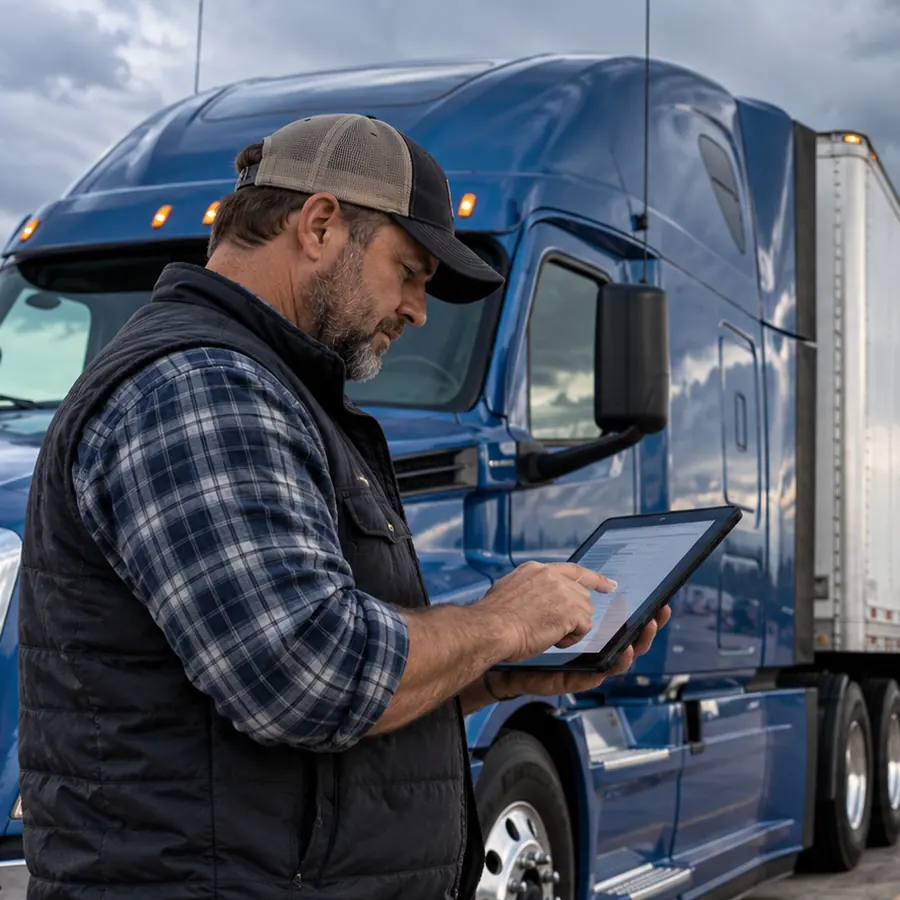
A severe-weather day rarely announces itself as one continuous emergency. A long-haul driver may leave under clear skies, cross a windy open plain by afternoon, and reach a line of thunderstorms near the delivery city after dark. The distance between those conditions can be hundreds of miles, which is why checking the weather at the starting point alone is not enough.
Good storm planning is less about guessing the perfect departure time and more about protecting options. A driver who knows where the rough conditions are likely to arrive, where a safe stop is available, and whom to call about a delay can make a calm decision before the road becomes difficult. The plan should remain simple enough to repeat on an ordinary workday.
Check the full route, not just the terminal forecast
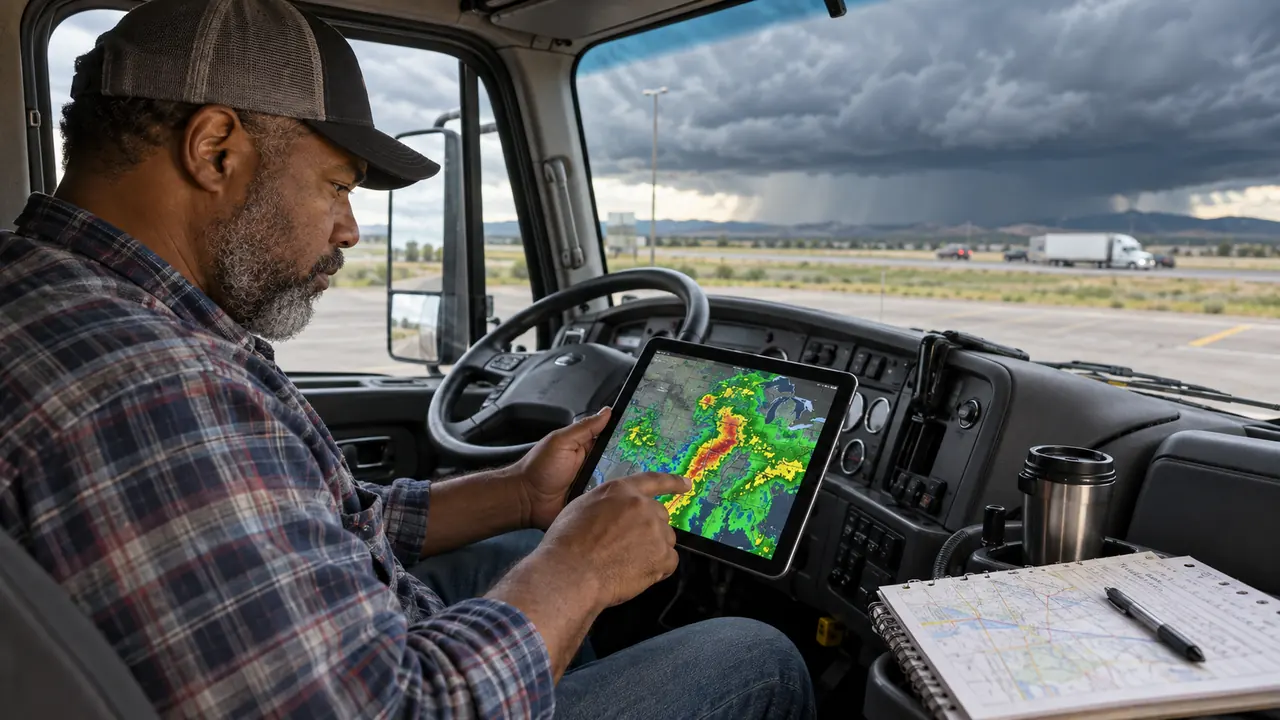
Before leaving, look at the forecast for the first leg, the middle of the route, and the destination. Check the timing of any watch or warning against your expected arrival, paying extra attention to exposed bridges, mountain gaps, and long stretches with few safe parking choices. Weather moves; an hourly forecast is useful as a planning estimate, not a promise that the storm will arrive at a particular minute.
Use the National Weather Service thunderstorm safety information and local alerts to understand the risk along your route. A watch means conditions are favorable for severe weather; a warning means a hazard is occurring or imminent in the warned area. Do not treat a watch as a guarantee that your route will be hit, but do use it as a reason to identify a stopping option before traffic and parking fill up.
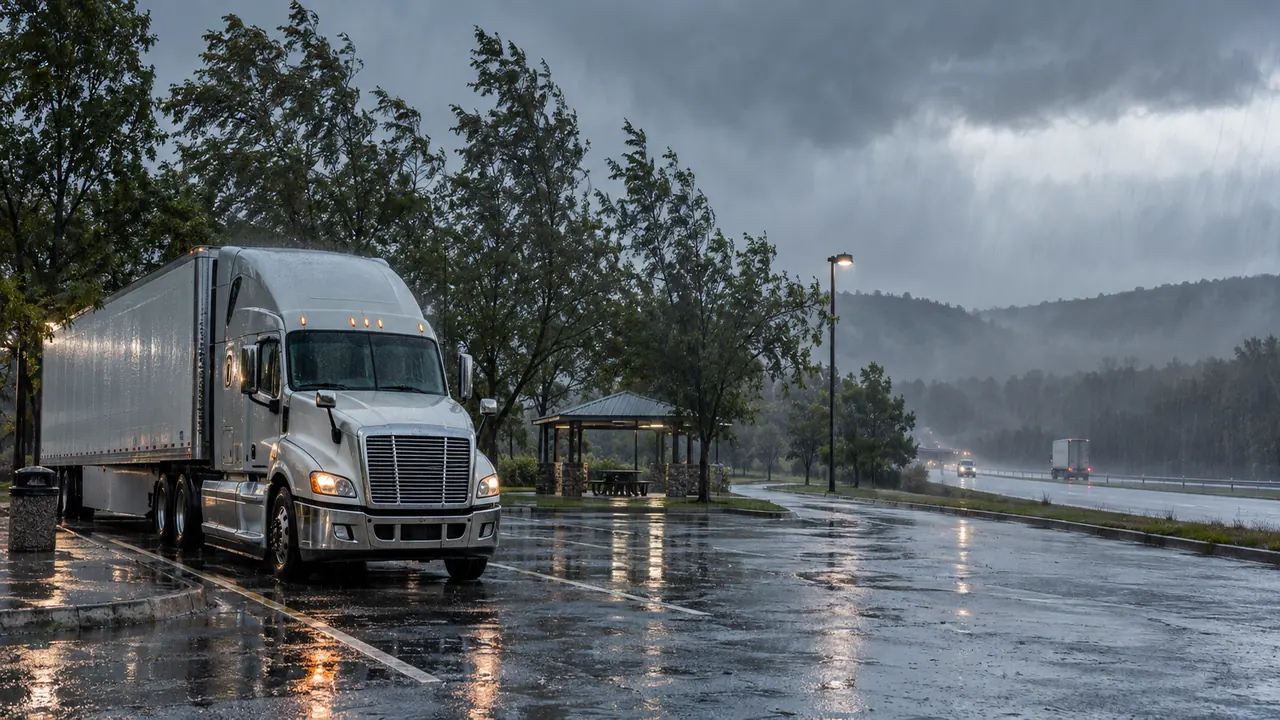
Make a primary and a backup stop. A truck stop, rest area, or customer lot can be useful if it is legal for your vehicle, reachable before conditions deteriorate, and reasonably protected from trees, power lines, or loose objects. A place that is excellent for a normal break may be a poor refuge in a severe storm. If a warning is issued, follow the local emergency guidance and seek substantial shelter when you can do so safely.
Think about wind differently in a high-profile vehicle
A semi-truck presents a large side area to crosswinds, and the way it responds depends on the trailer, load, direction of the wind, road exposure, and the driver’s ability to maintain control. An empty or lightly loaded trailer deserves particular caution. There is no single wind-speed number that makes every combination safe or unsafe; use the carrier’s operating guidance, current road restrictions, and the actual feel of the truck.
The National Weather Service warns that one strong gust can flip a high-profile trailer. Watch for gusts near gaps in buildings, at overpasses, along open fields, and when leaving a sheltered area. If the trailer begins to drift or the steering requires constant correction, reduce speed and find a suitable place to stop before control becomes marginal. Never rely on the fact that another truck has continued; its load and equipment may be different.
Weather warnings are also a reason to check state transportation notices. A road authority may impose temporary restrictions on high-profile vehicles or close a bridge. Those decisions take precedence over a navigation app’s original route. Avoid making a last-minute detour onto a road you have not checked for truck suitability.
Leave more room when visibility and traction change
Thunderstorms can combine heavy rain, standing water, wind gusts, and fast changes in visibility. The Federal Motor Carrier Safety Administration (FMCSA) advises commercial drivers to reduce speed for adverse weather and road conditions. That means slowing before a curve or a sheet of rain, not waiting until the truck has already begun to slide or the vehicle ahead has disappeared in spray.
Increase following distance and make braking and steering inputs gradual. Wet road markings, ramps, and bridge decks can feel different from the lane you just left. Do not use cruise control to push through a downpour, and do not try to recover a delayed schedule by closing the gap to the vehicle ahead. If visibility no longer supports a safe stopping distance, a safe exit and a pause are better than forcing the next few miles.
During the storm, keep scanning beyond the closest vehicle. A line of brake lights may indicate standing water, a fallen branch, or traffic stopped under an overpass. Do not stop under an overpass as an improvised shelter or on the traveled shoulder just to wait out rain. Choose a legal, safe place where the truck will not become a hazard to other traffic.
Communicate the delay before it becomes a crisis
A weather delay is easier for everyone when it is reported early. If a storm is likely to affect the appointment, tell dispatch what you know: your location, the weather alert or observed condition, where you plan to stop, and when you can check again. Do not promise a precise new arrival time while the warning is still active. Give a realistic update after conditions improve and the route is confirmed open.
Protect your attention during the drive. The FMCSA’s truck and bus safety guidance stresses planning and avoiding distraction. Pull over safely before studying radar, reading messages, or changing a route. An alert is useful only if you can act on it without looking away from the road at a critical moment.
Make the stop a genuine reset
Once parked, secure the vehicle, check the latest warning and road information, and make the cab comfortable enough to wait. Use the time to drink water, eat, and rest if your schedule allows. The goal is not to stare at the radar every thirty seconds. Set a sensible time to reassess, and pay attention to official updates rather than rumors from the parking lot.
If severe weather is imminent and a substantial building is available, follow local shelter instructions. A cab can protect you from ordinary rain, but it is not the preferred shelter for a tornado or extreme damaging wind. If you are already driving when conditions turn dangerous, make the safest available choice for the conditions you face and seek local emergency guidance. There is no universal parking spot that works for every storm.
After the system passes, take a moment before restarting. Walk around the truck when it is safe, look for loose equipment or debris, confirm lights and tires, and check whether your route has reopened. A short inspection is more useful than assuming that a quiet sky means the road is clear. If fatigue has built up during the delay, include that in the next decision too.
A small plan that travels with you
Before each weather-sensitive leg, ask four questions: What is forecast along the route? Where is my safe primary stop and backup? How will wind and rain affect this particular truck and load? Who needs an update if I stop? Keep the answers in a note that is easy to reach when parked, then refresh them at fuel or rest breaks.
Storms will continue to disrupt schedules. The practical advantage is having choices before the disruption reaches the windshield. A driver who checks the route, respects warnings, slows early, and communicates clearly can protect the truck, the cargo, and everyone sharing the road without turning every cloudy day into an emergency.